
Private Edwin Eugene Casey US Army
Class of 1898
"E.E. Casey, was born at Orneals, Nebraska, October 23rd, 1878. When he was about one year old his family moved to Colorado, locating near, what is now the town of Buena Vista. In September 1880, his parents came to this Territory, settling at Albuquerque. From there his family removed to the American Valley Ranch in the Southwestern part of Socorro County, where Eugene first learned to ride and where he received the first lessons in the hard work now before him. In 1886 his family moved to Socorro and from there, in the same year, came to Las Cruces. In the fall of 1888, when ten years old, Eugene entered the Las Cruces College, a private institution, conducted by—that celebrated Professor, Hiram Hadley. In this institution, under the personal supervision of Prof. Hadley, he progressed rapidly and when in 1890, the Las Cruces College was verged into our present Agricultural and Mechanic Arts College, with Prof. Hadley as President, Eugene entered as one of the youngest students in the preparatory Department, receiving his certificate of graduation in that department June 1st, 1893. In September 1893, he entered the regular College course, and passing with merit the various grades, graduated with the present Senior class, being the youngest graduate the College has turned out.
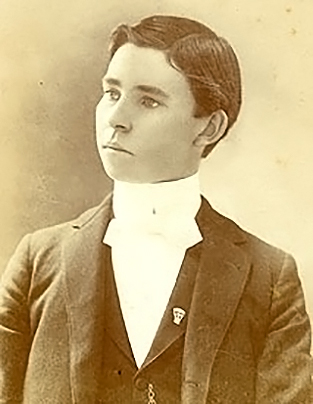
For three years Eugene has been Exchange Editor and Manager of the Collegian, doing good work and making a financial success of the paper.
This season he was manager of the College Foot Ball Team, bringing out the best talent and winning the Territorial Championship. He has also for some time past served as President of the Columbian Society, and was when he left Sec’ty of the Senior class. When the tocsin of war sounded and Columbia called on her patriotic sons to unfurl “Old Glory” to the breeze, Eugene was one of the first to respond, enlisting in Co. “H” U.S. Volunteers of New Mexico, under the valiant Captain Curry, of Col. Roosevelts Cow Boy Brigade by “Rough Riders” — commonly known as “Teddy’s Terror’s.”
The College justly feels proud of her boys who have gone to the front, and we know that they will defend our country’s flag to the last ditch—or in death be laid low, with their back to the field and their feet to the foe."
New Mexico Collegian, New Mexico College of Agriculture and Mechanic Arts. Las Cruces, New Mexico. May, 1898.
“ For the first time in the history of our college, it has become the painful duty of the Alumni Association to adopt resolutions on the death of one of its members. Edwin Eugene Casey died at Montauk Point, L.I. September 2nd, 1898 while in service of his country.....
…Although he never got to the front he deserves his share of the glory attained by his regiment at Santiago, for he was willing to go and lay his life At the altar of his country’s honor.
When his regiment was taken north from Tampa preparatory to muster out, he was stricken with typhoid fever and just as his family and friends were beginning to look forward to his home return, the sad news of his death came as a terrible blow in answer to their anxious waiting. …There is one consolation that his relatives and friends should ever bear in mind, that is he died in the service of his country and that there is no higher honor than to rest in the grave of a soldier who was serving his country in tie of war.”
New Mexico Collegian, New Mexico College of Agriculture and Mechanic Arts, Las cruces New Mexico, Vol.VI, October 1898. Number 5
Note: The Rough Riders were only permitted to take two-thirds of the regiment to Cuba. By a coin toss, it was determined that Troop H had to remain behind. The Troop stayed in Florida until the remainder of the regiment returned from Cuba, and was sent to Camp Wikoff, at Long Island's Montauk Point in New York. The troops that had been left behind in Florida were sent to Camp Wikoff to reunite with their comrades and reunite the regiment under one command.
Edwin Eugene Casey today rests in the Odd Fellows cemetery in Las Cruces New Mexico. He was 19 years of age when he gave his life in service to his nation.