
Captain Joseph Quesenberry, USA
Joe Quesenberry was born on September 17, 1894 in Las Cruces NM to James and Elizabeth Quesenberry. His father owned and operated a farm just north of town and was a respected agriculturalist that would go on to serve as a College Regent from 1917 to 1920. In 1910 Joe entered the 1st year prep program, essentially a freshman in high school, at NM A&M College. He was a large young man and played on the college football team that year along with two of his brothers. That year’s team was crowned Champions of New Mexico and Arizona. He would graduate from the prep school in 1914 and entered the college program in the fall of 1914 to study agriculture. In April of 1916 he departed the college to travel to the Dawd Preparatory School at Washington DC to study for the examination to be accepted as a Second Lieutenant in the Regular US Army.
During his time at NM A&M he was a three time all Southwest football selection, three time team captain, had played on three teams that were Champions of the Southwest, prominent in all student activities, and Major of the Cadet Battalion as a sophomore. After winning his commission he attended the Army School at Fort Leavenworth for three months and then was assigned to Laredo Texas.
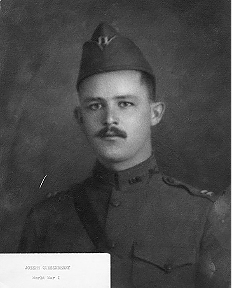
On May 31, 1917 he was transferred to Company K, 18th Infantry Regiment, 1st Expeditionary Division and went with it to France. This was the first division in France; first in sector; first to fire a shot at the Germans; first to attack; first to conduct a raid; first to be raided; first to capture prisoners; first to inflict casualties; first to suffer casualties; first to be cited singly in general orders; last to leave war zone. His unit arrived in France July 2, 1917. After weeks of training it entered the Sommerville Sector on October 21, 1917, moving on November 20th to the Ansauville Sector. It was reported in the Las Cruces paper the he was cited for bravery having on March 15th 1918 lead the attack which resulted in the capture of the first machine gun and the first German prisoners by American forces. Research found the report of an 87 man raid he led on the Remieres Salient on March 11th. While no prisoners were taken, they did capture the 1st German machine gun taken by American forces. More importantly however, it was the first raid by American forces led by an American officer. That commanding officer was Captain Joe Quesenberry. He received a congratulatory telegram from General Pershing and was commended, along with his raiding force of 87 men, by General Bullard on March 18th, 1918. On April 25th 1918 the American forces entered the Cantigny Sector. By this time Joe had been promoted to Captain in command of Company K but was actually assigned a Major’s role and responsibility to lead his Battalion in the coming attack. The great Spring Offensive began on April 28th, 1918 with the 1st Expeditionary Division leading the assault. During the assault Captain Quesenberry was mortally wounded from a shell explosion succumbing the following day, April 29th, 1918. Firsthand accounts reported that he demanded that his wounded troops received aid prior to his wounds being taken care of which ultimately resulted in his loss of life. Captain Joe Quesenberry lay in a French church cemetery near where he fell until 1921 when his body was brought home and reinterred in the Masonic Cemetery in Las Cruces. He was the first New Mexico A&MC Aggie to die as a result of enemy combat actions in service to our nation.
The Joe Quesenberry Post 10 of the American Legion was temporarily chartered August 5, 1919 and permanently chartered on May 8, 1926. Originally the Post was located on Main Street in Las Cruces. The present building was constructed and occupied in November 1958 at 1185 East Madrid Street.
On Monday, September 28, 1936, the NM A&M College athletic field, in an event which drew much of the community, was formally dedicated as Joe Quesenberry Field and would bear that name until 1950 when it was rededicated as Aggie Memorial Stadium with the opening of the Aggie Memorial Tower.