
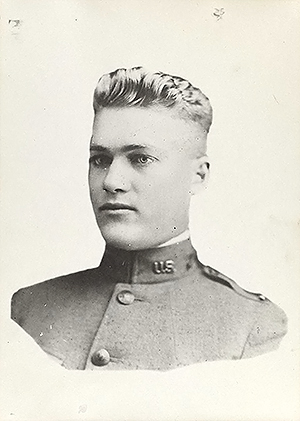
Lieutenant Arthur Warren Buell, USA
Arthur Warren Buell was born in San Pablo Colorado on July 23, 1897 to Reverend Warren and Louise Buell. His father was a minister in San Pablo at the time. In 1900 the family moved to Taos NM where Arthur attended the mission schools of the Presbyterian Church. In 1908 they moved to Mesilla Park NM where Arthur was raised. He attended the New Mexico Agriculture and Mechanical Arts College preparatory school for four years where he was a member of the football and basketball teams, and President of the junior class. In 1917-18 he attended NMAMC for his freshman year playing on the football team. In May 1918 he entered the US Army and began Officers Training at Camp McArthur near Waco TX. In July he was transferred to Camp Pike outside Little Rock Arkansas, the new home of the 87th Infantry Division, where he soon received his commission as a Second Lieutenant. He was soon thereafter transferred to Fort Roots, an older established post in Little Rock where he was placed in command of a company in the 18th Reconnaissance Battalion. On Wednesday December 18th his parents received word of his being seriously ill with flu. On Friday, just two days later they received a telegram notifying them of his death at Camp Pike Arkansas from pneumonia on Thursday, December 19, 1918. He was buried in the Masonic cemetery in Las Cruces. Arthur Warren Buell was 21 years of age at the time of his death while in service of his nation.
Comment:
The 1918 flu pandemic was an unusually deadly influenza pandemic, the first of the two pandemics involving H1N1 influenza virus. It infected 500 million people across the world, and killed 50 to 100 million of them—three to five percent of the world's population—making it one of the deadliest natural disasters in human history.
Most influenza outbreaks disproportionately kill juvenile, elderly, or already weakened patients; in contrast the 1918 pandemic predominantly killed previously healthy young adults. Modern research has concluded that theH1N1 virus kills through a cytokine storm (overreaction of the body's immune system). The strong immune reactions of young adults ravaged the body, whereas the weaker immune systems of children and middle-aged adults resulted in fewer deaths among those groups.
To maintain morale, wartime censors minimized early reports of illness and mortality in Germany, Britain, France, and the United States; but papers were free to report the epidemic's effects in neutral Spain creating a false impression of Spain as especially hard hit—thus the pandemic's nickname Spanish flu
This pandemic has been described as "the greatest medical holocaust in history" and may have killed more people than the Black Death. It is said that this flu killed more people in a year than the Black Death killed in a century. The majority of deaths were from bacterial pneumonia, a secondary infection caused by influenza, but the virus also killed people directly, causing massive hemorrhages and edema in the lung. The unusually severe disease killed up to 20% of those infected, as opposed to the usual flu epidemic mortality rate of 0.1%.
The outbreak is thought to have begun in January 1918. However by August 1918 the virus had mutated into the more deadly form. The greatest death toll in the US occurred near the end of October 1918.
(This information extracted from Wikipedia)