
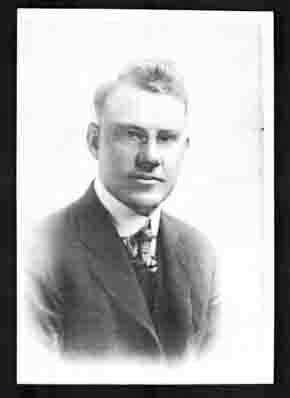
Private Hugh Arthur Carlisle, USA
Hugh Arthur Carlisle was born on November 28, 1890 in Ardmore Oklahoma to James and Belle Carlisle. His father was a rock mason and the family moved first to Hardeman TX before arriving in Las Cruces NM in the early 1900’s. In 1908 Hugh enrolled as a third year preparatory student at New Mexico Agriculture and Mechanical Arts College. He would complete his preparatory work in 1910 and in 1911 enrolled as freshman in the college. He was a prolific football player earning his letter in 1909 and 1910. In late 1910 he left Las Cruces to move to Estancia in Torrance County. In 1917, when he signed up for selective service, he was single, living at the YMCA in Albuquerque and working as a traveling salesman for Bond-Dillon. He also stated that he was seeking his commission as a Lieutenant in the New Mexico National Guard. In the summer of 1917 he married Miss Dorothy Safford of Santa Fe. He then enrolled and was attending school at UNM when he was called into active duty in July of 1918. He first went to Camp Travis in San Antonio TX and from there to Camp Wheeler in Georgia. He eventually sailed for France on October 7th 1918 with the Medical Detachment, 106th Field Signal Battalion. While on board ship there occurred an outbreak of the flu. On October 18th, 1918 Hugh Arthur Carlisle died of pneumonia resulting from the flu pandemic. Despite that fact that the ship had been out of port, his death occurred coincident with the highest mortality figures during the entire pandemic. He was buried at sea at 4 p.m. on the same date with full military honors.
The 1919 Swastika and corresponding Round Ups originally inadvertently failed to include him among their listing of Aggies to be honored. The May 1919 Collegian issued a correction which added his name among those Aggies who gave their lives in service to their nation. In 1925 a Round Up article included his name along with Captain Joe Quesenberry as among the greatest Aggies. Unfortunately, this information slipped from memory and only now are we able to insure proper recognition.
In addition, Hugh Carlisle was one of four students from UNM that died in WW I. UNM accordingly honored his memory by naming Carlisle Gymnasium in his honor upon its opening in 1927. It still exists on campus and is an historic building included on both the state and national historic property registers.
Comment:
The 1918 flu pandemic was an unusually deadly influenza pandemic, the first of the two pandemics involving H1N1 influenza virus. It infected 500 million people across the world, and killed 50 to 100 million of them—three to five percent of the world's population—making it one of the deadliest natural disasters in human history.
Most influenza outbreaks disproportionately kill juvenile, elderly, or already weakened patients; in contrast the 1918 pandemic predominantly killed previously healthy young adults. Modern research has concluded that theH1N1 virus kills through a cytokine storm (overreaction of the body's immune system). The strong immune reactions of young adults ravaged the body, whereas the weaker immune systems of children and middle-aged adults resulted in fewer deaths among those groups.
To maintain morale, wartime censors minimized early reports of illness and mortality in Germany, Britain, France, and the United States; but papers were free to report the epidemic's effects in neutral Spain creating a false impression of Spain as especially hard hit—thus the pandemic's nickname Spanish flu
This pandemic has been described as "the greatest medical holocaust in history" and may have killed more people than the Black Death. It is said that this flu killed more people in a year than the Black Death killed in a century. The majority of deaths were from bacterial pneumonia, a secondary infection caused by influenza, but the virus also killed people directly, causing massive hemorrhages and edema in the lung. The unusually severe disease killed up to 20% of those infected, as opposed to the usual flu epidemic mortality rate of 0.1%.
The outbreak is thought to have begun in January 1918. However by August 1918 the virus had mutated into the more deadly form. The greatest death toll in the US occurred near the end of October 1918.
(This information extracted from Wikipedia)