
Private Paul Brownlee ’14 USA
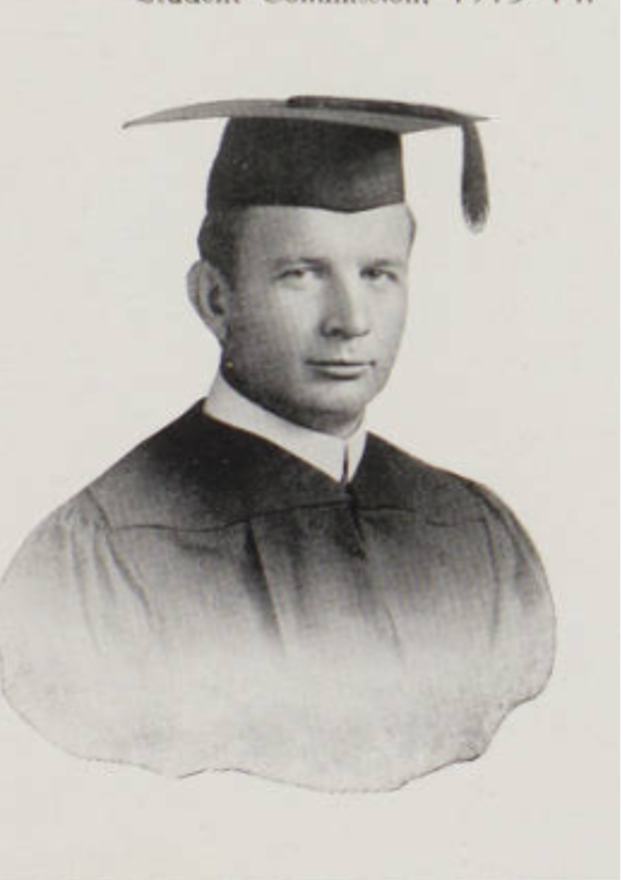
Paul Brownlee was born to Archibald and Lucy Brownlee on January 17, 1890 in Kansas. In 1907 the family moved to Las Cruces where Paul continued his education through enrollment in the New Mexico Agriculture and Mechanical Arts College. In 1914 he graduated with his bachelor’s degree in general science. While at the college he was a member of the student commission, athletic board and the 1909 football team. In August 1915, Paul departed Las Cruces for Filer, Idaho where he became principal of the local high school, returning to Las Cruces the following summer. In 1917, Paul was among the first in the Las Cruces community to enlist in the US Army under the selective service, departing for Camp Funston, Kansas shortly after September 7, 1917. The community turned out to show support for Paul and the other two young men so selected by holding a public reception including patriotic speeches. Around the end of October 1917, Paul was reported as ill with pneumonia in the base hospital but improving. However on December 2, 1917, Paul Brownlee died. Cause of death was listed as lobar pneumonia. His body was picked up by his father and brother and taken to Sylvia Kansas, where he was buried in the family plot. Paul Brownlee was 27 years of age when he died while in the service of our nation.
Some believe Camp Funston Kansas to be ground zero for the outbreak of the Spanish Flu. Earliest reported cases are generally thought to begin in January 1918, when generally healthy young men at the huge cantonment are struck down by a flu that quickly turns to pneumonia. We do not know what, if any, connection there may be between the death of Paul Brownlee in December 1917 and the ensuing outbreak the following month.
Comment:
The 1918 flu pandemic was an unusually deadly influenza pandemic, the first of the two pandemics involving H1N1 influenza virus. It infected 500 million people across the world, and killed 50 to 100 million of them—three to five percent of the world's population—making it one of the deadliest natural disasters in human history.
Most influenza outbreaks disproportionately kill juvenile, elderly, or already weakened patients; in contrast the 1918 pandemic predominantly killed previously healthy young adults. Modern research has concluded that the H1N1 virus kills through a cytokine storm (overreaction of the body's immune system). The strong immune reactions of young adults ravaged the body, whereas the weaker immune systems of children and middle-aged adults resulted in fewer deaths among those groups.
To maintain morale, wartime censors minimized early reports of illness and mortality in Germany, Britain, France, and the United States; but papers were free to report the epidemic's effects in neutral Spain creating a false impression of Spain as especially hard hit—thus the pandemic's nickname Spanish flu
This pandemic has been described as "the greatest medical holocaust in history" and may have killed more people than the Black Death. It is said that this flu killed more people in a year than the Black Death killed in a century. The majority of deaths were from bacterial pneumonia, a secondary infection caused by influenza, but the virus also killed people directly, causing massive hemorrhages and edema in the lung. The unusually severe disease killed up to 20% of those infected, as opposed to the usual flu epidemic mortality rate of 0.1%.
The outbreak is thought to have begun in January 1918. However by August 1918 the virus had mutated into the more deadly form. The greatest death toll in the US occurred near the end of October 1918.
This information extracted from Wikipedia