
Private Tom J. Duke, USA
Tom J. Duke was born sometime between 1897 and 1899 to Howard and Elva Duke in Stephenville, Erath County, TX. His records offer conflicting dates. He was their eldest son. His father was a cotton buyer. After completion of the 11th grade, Tom moved to Roswell NM where he went to work for the Roswell Auto Company as a vulcanizer. In 1917 he attempted to enlist in the US Navy but was not successful. On August 27, 1918 however he volunteered and was accepted into the US Army. He was then sent to the Student Army Training Corps, stationed at NM A&M College. There he was part of Professor Goddard’s radio operator’s class. In October 1918 Tom became ill during the height of the flu pandemic, eventually succumbing to pneumonia at the Fort Bliss Hospital on October 15, 1918. He was approximately 21 years of age. His body is buried at Evergreen Cemetery in Stephenville TX.
The Student Army Training Corps was a 60 day training camp established at colleges across the nation to augment the buildup of US Forces as the country entered the war. There were approximately 220 SATC “students” on the campus in the fall of 1918, far exceeding the college enrollment at that time. Seven young men from the SATC would die between October 15th and October 25th as a result of the flu.
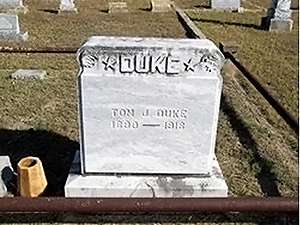
Comment:
The 1918 flu pandemic was an unusually deadly influenza pandemic, the first of the two pandemics involving H1N1 influenza virus. It infected 500 million people across the world, and killed 50 to 100 million of them—three to five percent of the world's population—making it one of the deadliest natural disasters in human history.
Most influenza outbreaks disproportionately kill juvenile, elderly, or already weakened patients; in contrast the 1918 pandemic predominantly killed previously healthy young adults. Modern research has concluded that theH1N1 virus kills through a cytokine storm (overreaction of the body's immune system). The strong immune reactions of young adults ravaged the body, whereas the weaker immune systems of children and middle-aged adults resulted in fewer deaths among those groups.
To maintain morale, wartime censors minimized early reports of illness and mortality in Germany, Britain, France, and the United States; but papers were free to report the epidemic's effects in neutral Spain creating a false impression of Spain as especially hard hit—thus the pandemic's nickname Spanish flu
This pandemic has been described as "the greatest medical holocaust in history" and may have killed more people than the Black Death. It is said that this flu killed more people in a year than the Black Death killed in a century. The majority of deaths were from bacterial pneumonia, a secondary infection caused by influenza, but the virus also killed people directly, causing massive hemorrhages and edema in the lung. The unusually severe disease killed up to 20% of those infected, as opposed to the usual flu epidemic mortality rate of 0.1%.
The outbreak is thought to have begun in January 1918. However by August 1918 the virus had mutated into the more deadly form. The greatest death toll in the US occurred near the end of October 1918.
(This information extracted from Wikipedia)