
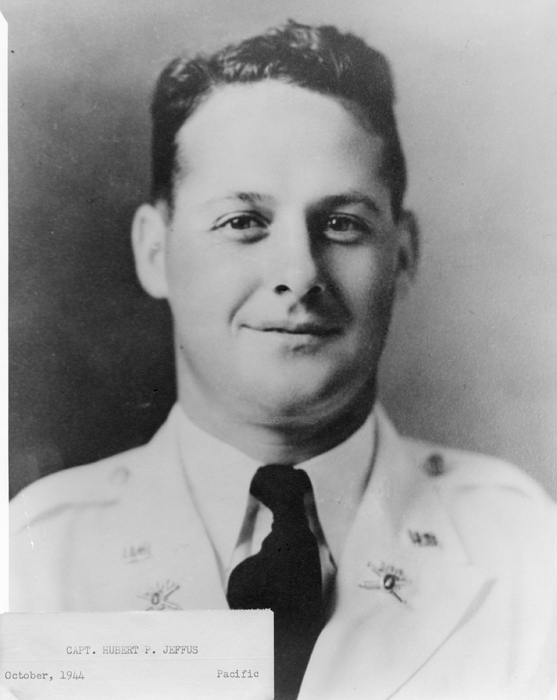
Captain Hubert Preston Jeffus
Hubert Preston Jeffus was born August 6, 1912 to Mr. and Mrs. GP Jeffus. He grew up in Lordsburg and graduated from Lordsburg HS in 1932. The next year he entered NMAMC where he studied Engineering before departing from school in 1935. While attending NMAMC he was a cheer leader and also lettered in basketball in 1935. In 1935 he married Miss Caroline Walker and they soon moved to Santa Fe where he was employed as an engineer. He was active in the NM National Guard and activated to federal service in January 1941.
In August, the 200th CA was dispatched to the Philippines.
On December 8, 1941, only nine hours after the Japanese attack of Pearl Harbor, the 200th CA engaged Japanese bombers at Clark Field and Fort Stotsenberg, becoming the first unit to go into action in defense of the U.S. flag in the Philippines. On April 9, 1942, the weakened survivors from the combined American and Filipino forces were unconditionally surrendered to the Japanese.
Most POWs were assembled in Mariveles at the southern tip of the Bataan peninsula and forced to march to San Fernando, Pampanga. Wounded men were assisted by able-bodied prisoners or carried on crude stretchers. Stragglers were beaten or killed. Civilians who showed mercy to the prisoners endured a similar fate. The incident covered a distance of 104 kilometers (65 miles) and became known as the Bataan Death March.
The final leg of the northward journey was completed inside stifling railway boxcars that took them to the prison set up at Camp O’Donnell. Most of the American POWs were eventually transferred to Cabanatuan. The captured soldiers were subjected to inhumane conditions. Death from malnutrition, disease and abuse was a common occurrence. More than 4,000 American POWs and 25,000 Filipino POWs died in these two camps alone.
In October 1944 as American forces were moving closer to the Philippines the Japanese engaged in transfer of those prisoners still deemed fit for duty as slave laborers to Japan and Manchuria. On October 11, 1944 Captain Jeffus and about 1800 other prisoners boarded the Arisan Maru. The ship steamed that day to avoid allied aircraft only to return to Manila harbor on or about October 20th. The next day the Arisan Maru joined with a convoy sailing for Japan. This was happening at the same time as the Battle of Leyte Gulf.
On the dark moonless night of October 24, 1944, the Arisan Maru was struck amidships by torpedoes believed to have been fired from the submarine USS Shark. The seas were high and it was bitterly cold in the South China Sea. The remaining Japanese ships made no effort to save prisoners that escaped the sinking shop and were in the water. Of the 1782 prisoners of war on the ship only 8 survived the night. It was the largest loss of American lives at sea in the entire war.
Today Captain Hubert Preston Jeffus is memorialized at the Manila American Cemetery and Memorial. He was 32 years of age at the time of his death and left behind his wife, Carolyn Walker Jeffus and son Donald Aubrey Jeffus.
Historical Source: Bataan Memorial Park in Albuquerque, New Mexico. Jack W. Bradley, 515th Coast Artillery, who, despite a debilitating illness, wrote the history — engraved on three of the columns