
Captain John Ray McCorkle
John Ray McCorkle was born in Seepes Springs, Texas on November 20, 1909 with his twin brother Robert Roy to John and Laura McCorkle. His family was a pioneering family in the Sacramento Mountains where his father farmed and his mother taught school. He grew up in Las Cruces, graduating from Las Cruces HS in 1928. He entered NMAMC the following year, graduating in May 1932 with a BS degree in Civil Engineering. As a student he was an accomplished athlete in both football and basketball, being selected as the Greatest Aggie for ‘31-‘32. He was class president, president of his fraternity Phi Chi Psi, and president of the honorary engineering fraternity Mu Phi Pi. In 1932 he married Nellie Starr, who he had met at school. Nellie’s father was Judge Starr who served as President of the Regents at NMAMC and also started the first chile canning process in Hatch NM. Following their marriage, Ray went to work for the Soil Conservation Service. He and Nellie subsequently had two children, Jeanine and Gerald. They lived in Silver City, Cortez and Montrose Colorado. The family was living in Montrose in the summer of 1941 when he was called to active service and in September 1941 he shipped to the Philippines.
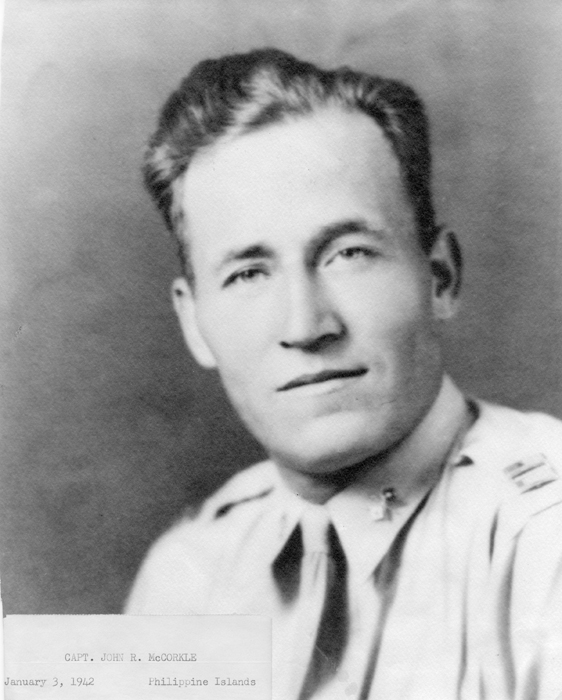
On January 28, 1942, Captain McCorkle led a small force of men forward on patrol to regain ground on the left flank of the battalion. He jumped to his feet and led a charge on an enemy position when he was repeatedly hit. He was dragged back to his lines and asked that they wipe the blood from his eyes so he could attack once more. He was unable to stand however and was carried back to aid stations. Unconscious and without identification, he lay in a field hospital for two days before briefly regaining consciousness just long enough to identify himself prior to dying. He was reported as buried in the Marivales Cemetery. However, attempts to locate his body following the liberation of the Philippines were unsuccessful. Today he is memorialized on the Manila American Cemetery Tablet of the Missing. He was 33 years of age at the time of his death and left behind his wife and two children.