
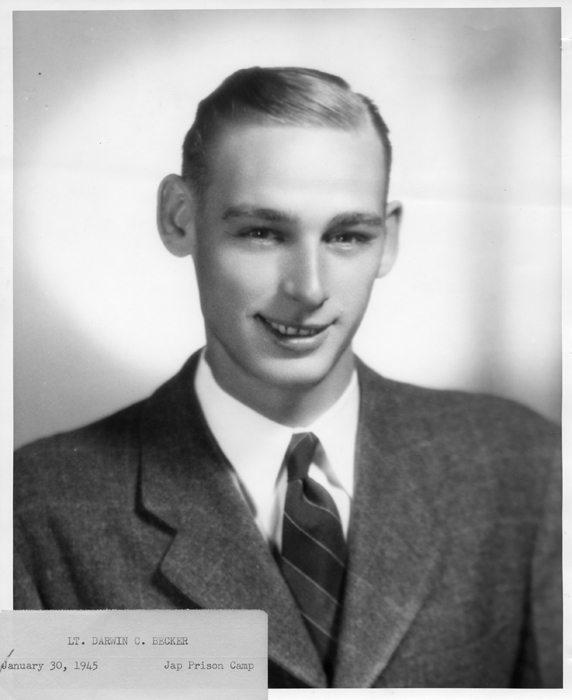
Lieutenant Darwin Charles Becker
Darwin Charles Becker was born in Texas on Nov 24, 1915 to Mr. and Mrs. Daniel Charles Becker. He grew up in Brenham TX where his father was a veterinarian and graduated from Brenham HS in 1934. He came to NMAMAC the following fall and stayed for one semester studying agriculture.
In the fall of 1941 Darwin entered the army under selective service and was assigned to the 200th Coast Artillery, New Mexico National Guard. In August, the 200th CA was dispatched to the Philippines.
On December 8, 1941, only nine hours after the Japanese attack of Pearl Harbor, the 200th CA engaged Japanese bombers at Clark Field and Fort Stotsenberg, becoming the first unit to go into action in defense of the U.S. flag in the Philippines. That evening, 500 soldiers from the original regiment of 1800 men were sent to provide additional air defense in Manila. This provisional force was christened the 515th Coast Artillery and became America’s first war-born regiment in World War II. Darwin Becker was assigned to Headquarters Company of the 515th. It was during this time that Darwin was given a battlefield promotion to Lieutenant.
On April 9, 1942, the weakened survivors from the combined American and Filipino forces were unconditionally surrendered to the Japanese.
Most POWs were assembled in Mariveles at the southern tip of the Bataan peninsula and forced to march to San Fernando, Pampanga. Wounded men were assisted by able-bodied prisoners or carried on crude stretchers. Stragglers were beaten or killed. Civilians who showed mercy to the prisoners endured a similar fate. The incident covered a distance of 104 kilometers (65 miles) and became known as the Bataan Death March.
Imprisoned as a POW for years, he was picked in December of 1944 to be transported to Japan for slave labor.
On the morning of December 13, 1,619 POWs boarded the Oryoku Maru, bound for Takao, Formosa, and Moji, Japan. On the morning of December 14, the convoy was attacked by US warplanes. The POWs endured seventeen such attacks before sunset. Only Oryoku Maru remained afloat. On the morning of December 15, U.S. Navy aircraft sank the Oryoku Maru near Olongapo Naval Station, Subic Bay, Luzon. Surviving prisoners were assembled nearby at some tennis courts. Of the 1,619 POWs aboard the "hell ship," as they termed it, only 1,290 answered roll call.
On December 27, the surviving prisoners boarded the Brazil Maru and Enoura Maru and sailed for Takao, Formosa. The ships docked there on New Year's Day 1945, and the prisoners received their first food since leaving San Fernando, On January 9, MacArthur's forces invaded Luzon. A simultaneous attack was made on Takao and both ships again came under US fire. On January 14, 1945 the remaining survivors were placed in the holds of the Brazil Maru and sailed for Moji Japan. When it arrived in Moji on January 29th it is reported that only 430 of the original 1,619 prisoners that boarded the Oryoku Maru were still alive. More died in the following days from exposure.
The next day the survivors were placed ashore and forced to sit overnight on the wharf adjacent to the ship in freezing weather. Lieutenant Darwin Charles Becker, after surviving all the trials up to this point, died from exposure, malnourishment and disease on January 30, 1945. His remains were cremated and subsequently were interred with the cremains of over 350 allied POW’s that died in Japan at the Yokohama British Commonwealth War Cemetery where they remain today. Lieutenant Decker was engaged to Miss Emmie Lou Ogden of Beaumont Texas at the time of his death. He was 30 years of age.
Historical Source: Bataan Memorial Park in Albuquerque, New Mexico. Jack W. Bradley, 515th Coast Artillery, who, despite a debilitating illness, wrote the history — engraved on three of the columns