
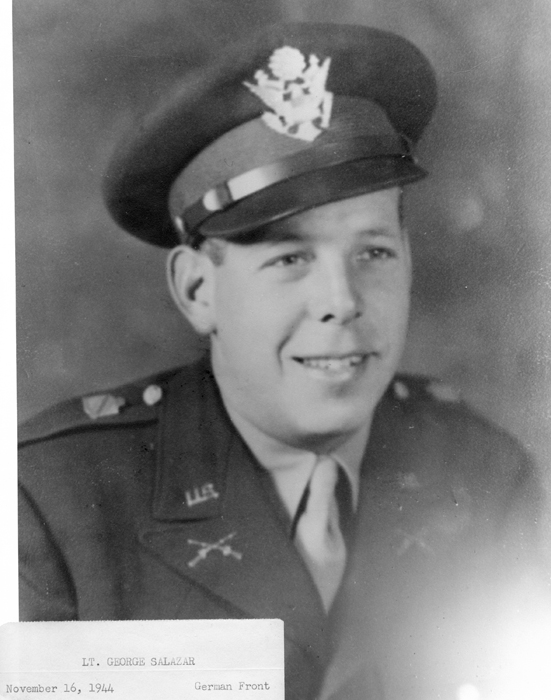
Lieutenant George Salazar
Silver Star
George L Salazar was born November 13, 1920 in Springer NM to Mal and Gertrude Salazar. He was their eldest son. The family remained in Springer where his father worked as manager of a pellet mill. After graduation from Springer HS in 1937 George enrolled at NMAMC to study engineering. After 2 and ½ years he left school to enlist in the US Army in July 1942. At the time of his enlistment he was married to the former Helen Clouthier. He was sent to California and then on to Fort Benning Georgia where he received his commission. For the next year or so he was assigned to three different posts along the east coast as an instructor. In June 1944 he was shipped to England and in August 1944 he was assigned to F Company, 2nd Battalion, 358th Infantry Regiment, 90th Infantry Division. The 90th ID had just come off the battle for Mont Forest de Castro where they suffered significant losses, including fellow Aggie Captain Oren Reichelt. He served as platoon leader and, as part of Patton’s Third Army, raced across France hitting at the retreating Germans. By November 1944 the 90th had reached the Mozelle River in eastern France and came up against the Maginot Line emplacements that had been converted by the Germans for their own use.
The following is extracted from the History of the 90th Infantry Division:
“Exactly at dawn 15 November the most violent counterblow of the campaign struck the 2nd Battalion 358th Infantry, positioned in and around Distroff France in the Lorraine Province near Fort Koenigsmacher. Preceded by a fierce artillery preparation two battalions of the 25th Panzer Division drove abreast into the town from the south, while a third in tanks and halftracks, enveloped from the east. The left (west) battalion never reached the town in strength thanks to the annihilating effect of the Division Artillery. But the other two, overrunning outposts, drove a wedge into the town splitting the defending garrison. In the town the 2nd Battalion, disdainful of odds, fought back with deliberate fury. The tanks, tank destroyers and infantry, stood their ground and, recoiling from the initial blow, exacted a heavy price. After four hours of savage fighting the attackers, recognizing the town to be impregnable and accepting failure, gradually withdrew. Behind them they left over 150 dead and wounded 40 prisoners and the chartered hulks of four tanks, four assault tanks, and 16 halftracks. On November 16 1944, the 2nd Battalion still reorganizing after the savage fight of the preceding day, patrolled south towards Metzervisse and found the railroad track north of that town heavily defended. Moving forward at 1400 2nd Battalion swung southeast onto the high ground and then turning abruptly to the right approached Metzervisse from the northeast under the cover of the massed artillery of the Division. The unexpected direction of the attack took the defenders unawares and by dark 2nd Battalion had cleaned out the town, capturing or killing its entire garrison.”
At some point during the battle on November 16, 1944 Lt. George L. Salazar was killed in action. He would be awarded the Silver Star for his actions. He was buried in the Lorraine American Cemetery. Lt George Salazar was 24 years of age at the time of his death and was survived by his wife and 2 month old daughter, Karen Sue, whom he had never met.