
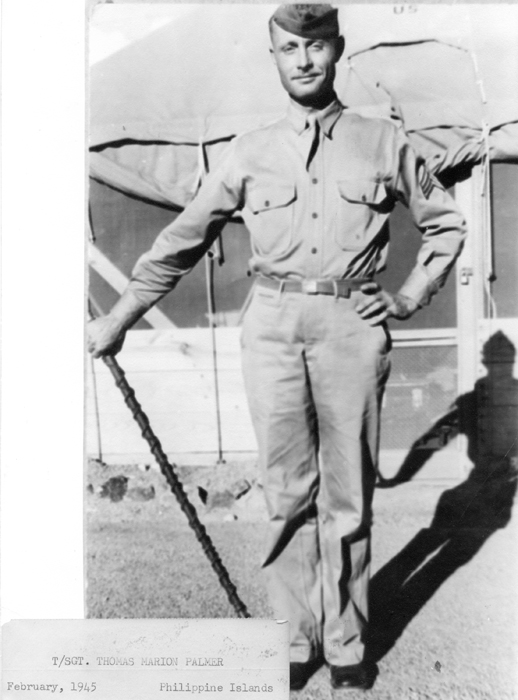
Tech Sergeant Thomas Marion Palmer
Thomas Marion Palmer was born to Mr. and Mrs. Marion Palmer on January 17, 1917. Raised with his family in Albuquerque, he graduated from Albuquerque High School in 1935 and enrolled at NMAMC the next fall. He attended NMAMC for two years studying engineering and participating in the school band playing trombone. Leaving school in the spring of 1937 he stayed in Las Cruces. He and his brother ran a filling station in Mesilla Park and he was a member of the New Mexico National Guard.
In the spring of 1940, the 111th Cavalry of the NM National Guard was converted to the 200th Coast Artillery Regiment and on January 6, 1941, he and the other members were inducted into federal service and immediately sent to the Anti-Aircraft Training Center at Fort Bliss, Texas. In August, the 200th CA was dispatched to the Philippines. TSgt Palmer served in the regimental band and performed for the unit while on board the ship in transit and upon arrival in the Philippines.
On December 8, 1941, only nine hours after the Japanese attack of Pearl Harbor, the 200th CA engaged Japanese bombers at Clark Field and Fort Stotsenberg, becoming the first unit to go into action in defense of the U.S. flag in the Philippines. On April 9, 1942, the weakened survivors from the combined American and Filipino forces were unconditionally surrendered to the Japanese.
Most POWs were assembled in Mariveles at the southern tip of the Bataan peninsula and forced to march to San Fernando, Pampanga. Wounded men were assisted by able-bodied prisoners or carried on crude stretchers. Stragglers were beaten or killed. Civilians who showed mercy to the prisoners endured a similar fate. The incident covered a distance of 104 kilometers (65 miles) and became known as the Bataan Death March.
The final leg of the northward journey was completed inside stifling railway boxcars that took them to the prison set up at Camp O’Donnell. . Most of the American POWs were eventually transferred to Cabanatuan. The captured soldiers were subjected to inhumane conditions. Death from malnutrition, disease and abuse was a common occurrence. More than 4,000 American POWs and 25,000 Filipino POWs died in these two camps alone.
Despite these obstacles, TSgt Palmer survived the war and was liberated from Bilibid Prison by American forces on February 10, 1945. Tragically however he was racked with beri beri (a disease caused by lack of vitamin B1) and malnutrition. His parents would receive a telegram on 23 February 1945 from him stating “Am a prisoner of war no longer. Watch papers for details”
Two days late, on February 25, 1945 they received a telegram from the Secretary of War informing them that TSgt Marion Palmer had died on 13 February, shortly after liberation. Several months later they received a package from a doctor that attended him. In it were contained his razor, a toothbrush, a pencil and a little bible. Also included was a note he attempted to write to his parents shortly after being liberated. The note stated “My hands still are in bad shape from beri beri…. This letter is incredibly tiring and I have to stop frequently to rest…we can truthfully say we have come out of hell into the promised land “. Then he lapsed into unconsciousness and died shortly there after
TSgt Thomas Marion Palmer died at Camp 10B, Bilibid Prison at the age of 28. Today his remains rest at Sunset Memorial Park Cemetery in Albuquerque.
Historical Source: Bataan Memorial Park in Albuquerque, New Mexico. Jack W. Bradley, 515th Coast Artillery, who, despite a debilitating illness, wrote the history — engraved on three of the columns